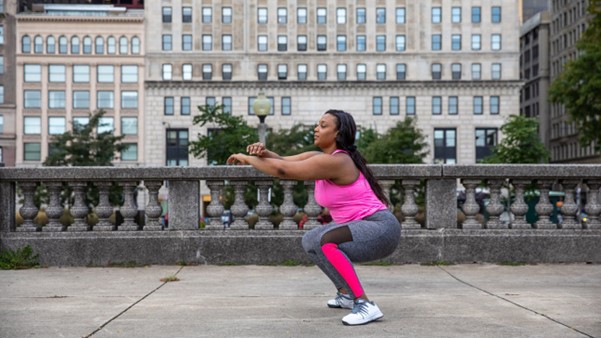
Bodyweight training is a popular and accessible method of improving your strength and conditioning with minimal to no equipment.
When it comes to building stronger legs, bodyweight training offers you a variety of options to target the muscles in your lower body.
Types of bodyweight leg exercises
Most variations of bodyweight leg exercises fall into one of the two following movement patterns:
- squat pattern
- lunge pattern
10-minute bodyweight leg workout (no equipment)
-
Warm-up: 60 sec (bodyweight squats + hip hinge)
-
Circuit: 3 rounds
-
Squats x 12
-
Reverse lunges x 10 each side
-
Glute bridge x 15
-
Calf raises x 20
-
Wall sit x 30–45 sec
-
-
Rest: 30–60 sec between rounds
- quadriceps
- gluteus maximus
- calves (soleus and gastrocnemius)
- hamstrings
- Stand with your feet around shoulder-width apart and turned out 5–12 degrees.
- Begin the motion by moving your hips backward, sitting back, and lowering your hips. Reach your arms out in front for counterbalance.
- As you sit back, generate tension in your feet and legs by imagining you’re pushing your knees outward and sitting down between your thighs, as opposed to on top of them. This is to counteract the tendency to let your knees cave or turn inward.
- Lower your hips until the tops of your thighs are parallel to the floor. You can go lower if your mobility allows.
- Once you reach the bottom position, push through each foot evenly to stand up to the starting position.
- Keep your knees pointing in the same direction as your toes throughout the entire range of motion.
- Your torso should be roughly at the same angle as your shins throughout the motion. This means that you’ll lean slightly forward as you squat down, and your knees will move slightly forward as well.
- Position a chair of around 18 inches (45.7 cm) high behind you.
- Stand about 1 foot (30.5 cm) in front of the chair, with your feet around shoulder-width apart and turned out 5–12 degrees
- Begin the motion by moving your hips backward, sitting back, and lowering your hips.
- As you sit back, generate tension in your feet and legs by imagining you’re pushing your knees outward and sitting down between your thighs, as opposed to on top of them. This is to counteract your knees’ tendency to cave in or turn inward.
- Lower your hips until your hips touch the chair. Don’t sit down on the chair.
- As soon as you feel your hips contact the chair, push through each foot evenly to stand up to the starting position.
- Keep your knees pointing in the same direction as your toes throughout the entire range of motion.
- Your torso should be roughly at the same angle as your shins throughout the motion. This means that you’ll lean slightly forward as you squat down, and your knees will move slightly forward as well.
- Stand with your feet around shoulder-width apart and turned out 5–12 degrees.
- Begin the motion by moving your hips backward, sitting back, and lowering your hips. Reach your arms out in front for counterbalance and swing them backward at the bottom to generate momentum for the jump.
- Lower your hips until the tops of your thighs are parallel to the floor.
- Once you reach the bottom position, explosively drive through each foot and rapidly stand back up. In the same motion, extend your feet and push through your toes to completely clear the floor and jump off the ground. Throw your arms upward as you leave the ground.
- As you land, absorb your weight by squatting right back down using the same technique.
- Keep your knees pointing in the same direction as your toes throughout the entire range of motion.
- If performing for repetitions, the landing absorption becomes the initial downward squat movement for the next jump squat repetition.
- quadriceps
- hamstrings
- glutes
- The standard bodyweight lunge is the first lunge variation you should learn.
- To perform the standard bodyweight lunge:
- Begin standing with your feet hip-width apart.
- Take a large step forward. The exact distance will depend on your body size but should be roughly 2–3 times the distance of a normal walking step. Your front foot should be pointing directly forward. Your back foot will be turned out very slightly.
- Lower your hips by slowly bringing your back knee toward the ground. Actively rotate your back foot inward and raise your back heel as you lower your knee for optimal movement. Your front knee will bend as your center of mass lowers.
- Continue lowering your body until your back knee is just off the ground. At the bottom of the lunge, your front shin should be perpendicular to the floor or angled forward slightly.
- Push through your front foot to stand straight back up to the starting position.
- You can alternate legs each repetition or stay in the staggered stance and perform one side all the way through before switching.
- Begin standing lunge-distance in front of a roughly 18-inch (45.7-cm) tall chair seat with your feet hip-width apart.
- Place one leg behind you on the chair. You can have the balls of your feet and toes on the chair or point your foot, so the top of your foot is in contact with the chair. Try both positions to see which is more comfortable.
- At the top position, your front shin should have a slight rearward angle.
- Lower your hips by slowly bringing your back knee toward the ground. Focus on lowering your back knee and hips and avoid driving forward with your front knee.
- Continue lowering your body until the top of your front thigh is parallel to the ground. At the bottom of the split lunge, your front shin should be perpendicular to the floor or angled forward slightly.
- Push through your front foot to return to the starting position. Focus your pressure in the rear-third area of your front foot.
- You can alternate legs each repetition or stay in the staggered stance and perform one side all the way through before switching.
- Begin standing with your feet hip-width apart.
- Take a large step forward. The exact distance will depend on your body size but should be roughly 2–3 times the distance of a normal walking step. Your front foot should be pointing directly forward. Your back foot will be turned out very slightly.
- Lower your hips by slowly bringing your back knee toward the ground. Actively rotate your back foot inward and raise your back heel as you lower your knee for optimal movement. Your front knee will bend as your center of mass lowers.
- Once your back knee is roughly 6 inches (15.2 cm) off the floor, explosively drive through your front foot and jump off the ground.
- In midair, switch your feet and land in a lunge position. Your front foot on the previous lunge will now be your rear foot.
- Use the same lowering portion of the lunge technique to safely absorb your body weight.
- Continue directly into the next repetition once your rear knee reaches full depth.
- Stand with your feet hip-width apart.
- Aggressively raise one knee, keeping the foot on the raised leg flexed.
- As you raise your knee, push through the floor with your planted foot to lift your heel off the ground.
- Once your top thigh is parallel to the ground, aggressively drive that foot heel-first to the floor to step forward. Once your heel hits the ground, “paw” the ground by coming up onto your toes and fully pointing your foot, elevating your heel off the ground.
- As you paw the ground with your planted foot, aggressively raise the other knee to prepare for the next skip.
- Let your arms swing naturally by having the opposite arm swing upward with the opposing knee.
- Stand with your feet hip-width apart and take a large lateral step with one leg directly to your side. Your toes should now be on the same line with your feet far apart.
- Bend your knee on the side you stepped with and sit your hips back to lower your body to the bottom of the lunge. Your other leg should be straight. Put your hands in front of you to balance, and avoid letting your knee shoot past your toes.
- Push through your heel on the lunging leg to stand up straight and return to the start position.
- Repeat on the other leg.
- Stand with your feet hip-width apart with a 6–12 inch (15–30.5 cm) high stepping surface in front of you.
- Take a step and place your front foot on the surface.
- Push through your front foot and fully extend through your knee and ankle to stand up straight on the step.
- Raise your other knee until your thigh is parallel to the floor. Do not place your back foot on the step.
- Return your back foot to the original position and step your front foot (the one on the elevated surface) back to the starting position.
- Alternate sides or repeat on the same side for the target number of repetitions.